The Ages and Stages of A Self-Directed Education
What thirty years of watching students grow has taught us about the arc of a self-directed education, and why the hard parts are part of it working.
Here is a conversation we have with parents almost every year.
"Something's changed. In September she couldn't wait to get to school. Now she says there's nothing to do. Is it not working?"
It's one of the most common worries we hear at Alpine Valley School, and our answer usually surprises people: this is right on schedule. In fact, it's often a sign that something important is about to happen.
Students at self-directed schools tend to move through a recognizable arc of growth. We've watched it unfold since 1997, and when staff members from self-directed schools around the world compare notes, we describe the same pattern to each other, almost stage for stage. Researchers studying schools like ours are starting to map it too: an arc that runs from playful exploration, to increasingly sustained engagement, to reflective self-regulation, and finally to conscious choices driven by a young person's own values.
We want to share that arc with you, for one simple reason: when your child is in a hard stretch (or a glorious one), it helps to know that the stretch has a name, that other kids have been there, and that it will almost certainly change. An education shaped by its participants in an intentional community comes with real ups and downs. Riding those out, together, is part of the deal, and it's where a lot of the growth actually lives.
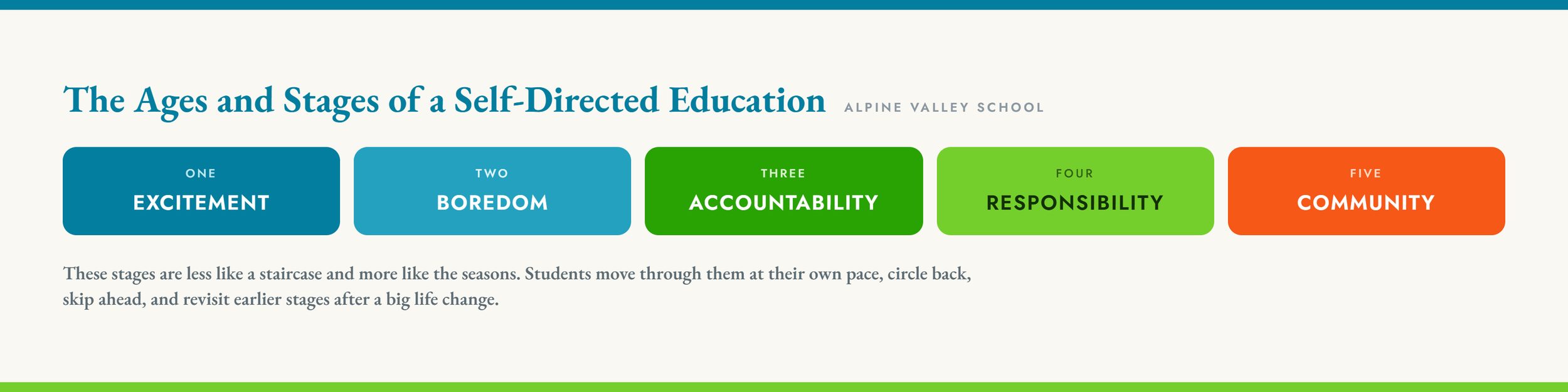
One thing before we start: these stages are less like a staircase and more like the seasons. Students move through them at their own pace, circle back, skip ahead, and revisit earlier stages after a big life change. A ten-year-old and a fifteen-year-old can be in the same stage; the same child can touch two stages in one week. The map is here to orient you, but it's important to remember that every child walks it their own way.
Stage One: Excitement (the honeymoon)
For many kids, arriving at a self-directed school is the first time they experience real liberty over their own time, and it is electric. They're happy coming to school, they often can't wait to get there, and they don't want to leave at the end of the day. There is so much to explore: getting certified to use the kitchen or the art supplies, figuring out how School Meeting works, discovering the corners of the campus, and yes, testing the boundaries to find out what's actually possible and what breaks the rules. (That testing is learning too.)
What can be hard: Making friends comes easily to some kids and slowly to others, and watching your child navigate a new community is tender territory for any parent. The bigger challenge is simpler: the honeymoon ends. After two or three weeks the newness wears off, and that shift can feel jarring, especially when the first weeks were so shiny.
For parents: Enjoy it! And hold it lightly. The honeymoon is real, and so is what comes next.
Stage Two: Boredom
This is the stage that scares parents most, and it's the one we most want to reframe for you.
After the honeymoon fades, many students hit a stretch of wandering. They drift around seeing what other people are doing. They complain that there's nothing to do, or no one to do it with. "What happened at school today?" gets answered with "Nothing." Some kids grow reluctant on school mornings. Some start to worry out loud that they aren't learning anything. And because their time is fully theirs to fill, they sit with a question most kids never get to face on their own terms: what do I actually want to do?
That question is the whole point. Families who leave conventional schooling often describe a "deschooling" period, an adjustment stretch in which a young person gradually stops waiting to be told what to do and starts generating their own direction. Researchers who study motivation describe something similar: the shift from doing things because someone requires it to doing things because they matter to you takes real time, and the uncomfortable in-between is where the shift happens. Boredom, it turns out, is a doorway. On the other side of it is nearly every deep interest we've ever watched a student develop.
What can be hard: You may hear real complaining at home, which stings after such a happy start. Restlessness is uncomfortable for kids and for the adults who love them. And some kids, casting around for something to do with themselves, find trouble to get into. (See Stage Three, which often arrives right on cue.)
For parents: This is the stage where families most need to hold steady. Resist the urge to rescue your child from their boredom; it resolves best from the inside. Curiosity helps more than solutions: "What are other kids up to? What looks interesting, even a little?" And know that this stage, uncomfortable as it is, has launched more passions at AVS than any other.
Stage Three: Accountability
Somewhere along the way, often through the school's justice system, a student runs headlong into a big realization: I am the author of my experience here. Maybe they get written up for breaking a rule. Maybe they write someone else up and watch the process work. Either way, something clicks. The daily governance is real, the community is real, and they are a full participant in both.
We think of accountability as distinct from responsibility. Accountability faces inward: owning your choices, your time, your way of showing up. (Responsibility faces outward, toward the community, and it usually comes later.) In this stage, students start engaging with the school's systems in earnest. They serve on the Judicial Committee and learn how our accountability process really works, sometimes reluctantly at first. They do their chores without being reminded. They begin choosing to be at school, engaging with it on purpose, sometimes even trying to improve it. This also tends to be the stage where students opt into more formal classes and activities, testing what tools for learning work best for them.
What can be hard: Taking personal accountability is confronting at any age. There can be a real journey between breaking a rule and owning it, with plenty of dodging and consequence-avoiding along the way. That journey is the curriculum. Students in this stage also sometimes burn with frustration at peers who aren't holding themselves accountable, which is its own lesson in living alongside other people.
For parents: If your child comes home indignant about a write-up, try to hear it as growth in progress. A child wrestling with fairness, consequences, and their own part in things is doing some of the most important learning our school offers.
Stage Four: Responsibility
This stage can take years to reach, and that's fine. It arrives when a student realizes they are more than an individual navigating the community: they hold a piece of the community itself, and it asks something of them.
You'll see it in students running for elected positions, clerking the Judicial Committee, chairing School Meeting, voting thoughtfully in school elections, making and debating motions. You'll hear it in the questions they ask: why do we do things this way? Could this work better? What roles here, and out in the larger world, might be worth pursuing? We see this most in our older students, and every so often a younger student gets there early and astonishes everyone.
What can be hard: Some students take on too much out of sheer abundance of care, and learning to balance commitments is part of the work. Others feel they aren't doing enough, measuring themselves against an imagined picture of what school is "supposed" to look like. Parental expectations can weigh heavily here too. If you have strong feelings about what your child should be doing at school, this is the stage where those feelings tend to surface, and it's worth talking with us about them.
For parents: Notice what your child is carrying, and celebrate it. A teenager who chairs a meeting of five-year-olds and adults as equals, keeps order, and gets the group to a decision is practicing something most people don't attempt until their thirties (if then).
Stage Five: Community
In this stage, a student is fully woven into the life of the school. They know their presence matters, and that the school runs the way it does partly because of them. Ideally they've found a healthy balance: engaged in their responsibilities, accountable for themselves, and at home in a moral community full of people different from them.
Students in this stage become advocates. They show up at open houses, welcome new students, and speak beautifully about the school because they're describing their own life. Many love teaching others what they've learned in some deep pursuit. They reflect on their own arc, often with striking clarity about the earlier stages, and about the younger kids currently walking through them.
What can be hard: Even our most deeply engaged students sometimes look sideways at their conventionally-schooled peers and wonder whether what they're doing "counts." The freedom to choose your own path can coexist with worry about the road untaken, especially for students who've grown up here and have never known anything else. This is a juncture where support from parents and staff members matters enormously. The evidence is on their side: follow-up studies of graduates of schools using our model have found that they get into the colleges they aim for, build careers full of creativity and deep meaning, and credit their schools with exactly the qualities this arc develops. Their worry is understandable, and it's also answerable.
For parents: Keep the long view where your child can see it. "That counts" may be the most powerful sentence you can offer a self-directed young person, because every bit of their journey does.
A few honest notes about the map
Kids arriving from conventional school often need a healing stage first. Before the honeymoon, or woven through it, many students who've had a hard time in school before arriving here spend a while simply recovering: resting, playing, letting their guard down, remembering that learning can feel good. This is real work, and it deserves the time it takes.
The stages aren't linear, and they aren't the same for everyone. Students move backward as well as forward. A hard year at home can send a fifteen-year-old back to boredom; a single School Meeting can vault a nine-year-old into accountability. All of it is welcome.
Give it two years. Staff members at self-directed schools around the world say the same thing: it takes about two years to see the results of this kind of education take root. That is a long time to trust a process, and we don't ask it lightly. We ask it because we've watched it pay off for thirty years, and because the research on motivation backs it up: one large study of thousands of students found that the usual adolescent backslide in the desire to learn simply didn't happen at schools where students direct their own learning. The love of learning holds. It just needs room, and time, to do so.
Every stage in this arc, including the uncomfortable ones, has its part to play. The boredom feeds the passion. The write-up feeds the accountability. The overcommitment feeds the balance. If your child is in a hard place right now, that place is on the map, it has a name, and it leads somewhere. And if they're in an awesome place, savor it, and know the road will bend again.
Wherever your child is on this map, we're walking it with you. If you ever want to talk through what stage your kid seems to be in and what support looks like right now, come find us. That conversation is one of our favorite (and most important) parts of the job.